Category: music history


  • by Mike Magers

    The song alternately known as the “Navy Hymn,” “For Those in Peril on the Sea” or “Eternal Father, Strong to Save” dates back to 1860. During the 19th century, hymnbooks typically included sections of hymns devoted to the subject of divine protection for travelers, particularly for naval travel.

    This hymn has likely been the most commonly performed piece of that type over the years. The words were written by clergyman William Whiting and the melody was composed by clergyman and musician John B. Dykes, both of the United Kingdom. Hymn tunes are given names and Dykes named his composition “Melita” in reference to the island where the biblical apostle Paul was shipwrecked in Acts 27. Whiting, who lived in London, is said to have written the words to go with the melody to comfort a young person who was about to set sail for America.

    Whiting (1825−1878) was Master of an Anglican school for musicians and had himself survived a violent storm at sea during which the ship was in danger of being lost. While teaching at the Winchester College Chorister’s School, the story is told, he was approached by a student who related his fear of traveling to Whiting. In response, Whiting wrote a poem that became the basis for the words of the hymn which was published about a year later. Whiting continued to modify the words of the songs as long as he lived, but the words commonly used in hymnbooks have remained relatively standard for many years.

    John Bacchus Dykes (1823−1876) came from a family that included a number of clergymen, but his gift was music. It is said that he was proficient on various instruments, primarily keyboards, violin and horn, and he had been involved performing and composing religious music since his youth. Dykes primarily worked as a church musician and composed complete hymns, dozens of hymn tunes and edited hymnbooks. In addition to the hymn tune used for the Navy Hymn, Dykes also composed “Nicaea” which many would recognize as the melody for the hymn “Holy, Holy, Holy.”

    Use of this hymn by the United States Naval Academy is believed to date back to around 1879 when Rear Admiral Charles Jackson Train instituted it as part of Sunday divine services at the Academy.

    The hymn was gradually added over time to the naval military traditions of the United States, Great Britain and France. It has also been associated with historical occasions. It is said to have been the favorite hymn of President Franklin Delano Roosevelt and was sung at his funeral. It was also performed as the casket of President John Fitzgerald Kennedy was carried up the steps to the United States Capitol Building to lie in state.


    Youtube link to the United States Naval Academy Glee Club performing the Navy Hymn, acapella version.

    Youtube link to the United States Marine Band performing an instrumental version of the Navy Hymn.

    Dedicated to Lieutenant Commander Carl B. Bolin, USN.


  • By Mike Magers

    What music should be associated with the Alamo? There are at least two pieces that are known as El Degüello (alternatively spelled El Dagüello or simply the “Americanized” Deguello). The first is a bugle call traditionally thought to have been played by the Mexican Army and the second is a hauntingly beautiful melody that appears in films such as “Rio Bravo” and “The Alamo.” The latter melody, though a lovely one, is not associated with the actual historical event.

    The bugle call is thought to have been one of several dozen commonly used by the Mexican Army led by General Antonio López de Santa Anna on March 6, 1836. The term El Degüello is believed to have been derived from Spanish bugle calls signalling “attack/beheading/throat cutting/no quarter” or “death without mercy.”

    There were no eye witness accounts that survived to verify the melody, but Amelia Williams wrote an article called “A Critical Study of the Siege of the Alamo” for the Southwestern Historical Quarterly issue of Jan., 1934, published by the Texas State Historical Association. In it Ms. Williams writes of the playing of “the dreadful deguello” and stated that the music had many variants. In her footnotes, she gives credit to Professor Samuel E. Asbury of Texas A&M University for initiating her research on the bugle call and also credits Mr. Luis Chavez Orosco of Mexico City for locating it. Mr. Orosco had been hired by the Mexican government to help document the history of the Texas Revolution. Mr. Orosco’s research led him to the archives of the Mexican Army and to identify the melodies which were most likely used back then for bugle calls. Near the end of her article, she included a page that presented four movements of the bugle call melody, one of which is labeled Vivo. It is this movement that is often heard and associated with the Alamo. The entire page may be viewed here.

    We will close with the embedded video clips below that pertain to the two melodies. The bugle call begins about 10 seconds into the video below. The playback stops when the dialogue begins. This particular clip features audio in Spanish, but it is not difficult to follow. It is from the 2004 film “The Alamo” directed by John Lee Hancock.

    Most likely it was some variation of the bugle call that was played at the Alamo in 1836. The three Youtube links and clips below incorporate the beautiful melody that was originally composed by Dmitri Tiomkin. It is also called The Deguello. It appears to have first been used by Tiomkin in the sound track of the movie “Rio Bravo” and later in “The Alamo” both starring John Wayne and others.

    Howard Hawks directed “Rio Bravo,” released in 1959.

    John Wayne directed “The Alamo,” released in 1960.

    Two popular adaptations of the Tiomkin melody.


  • By Mike Magers

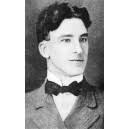
    Frank White Meacham was born in Buffalo, New York in 1856 to John Horace Meacham and Mary Emma Page Meacham. He was the middle child of at least five siblings. In the 1865 census, John Horace’s profession was listed as broker and in the 1875 census when Frank was 19, John Horace’s profession was listed as (possibly carriage) manufacturer. Five years later in the 1880 census, Frank was living with his family at age 24 and his profession was listed as musician. Little appears to be documented about his musical training.

    Frank married the former Cora B. Collins. In the 1892 New York census, he was 36 and she was 26. His profession was listed as musician. No children were listed. Frank Meacham lost both parents as a result of a buckboard/train accident on November 20, 1894. The buckboard in which they were riding was hit by an oncoming train at an at grade crossing in Germantown, Pennsylvania where they were residing. Mr. Meacham was killed instantly. A railroad flagman and Mrs. Meacham died shortly thereafter from their injuries.

    Frank is known to have composed a number of songs, beginning with “Come Over the Sea” which is said to have been composed when he was only 10 years old. The Library of Congress contains images of a number of his compositions including “Come Over the Sea” published in 1877 by Chandler Brothers, “The Tar’s Farewell” also published by Chandler Brothers in 1878, a collection including “My Little Bouquet,” “Locust Grove Waltzes,” “Woodland Nymphs Galop,” “Esopus,” “Tarantelle” and “Rosenvik Waltzes” published in 1880 by George Molineaux of Brooklyn and “Celestial Waltzes” also published by Molineaux in 1881. He is also believed to have arranged and ghost written songs for others.

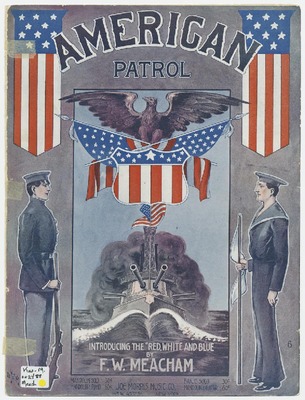
    His most enduring composition has been “American Patrol.” Originally a piano piece, it was copyrighted in 1885. The first band arrangement is believed to have been published by Carl Fischer in 1891 and published again in 1919 by his widow Cora Meacham. In an interesting cross-genre application, the melody and basic themes were again arranged for swing band by Jerry Gray and later by composer Morton Gould. The swing band arrangement was recorded and made popular by the Benny Goodman band.

    Image credit: umaine.edu

    Meacham died in 1909 and is interred along with his parents at Albany Rural Cemetery in Menands, New York.


    Frank W. Meacham’s American Patrol – Youtube

    ,

  • By Mike Magers

    Wagner was the composer of a well known march called “Under the Double Eagle” in 1893. It has been so often performed by United States bands over the years that it could easily be mistaken to be an American patriotic work.

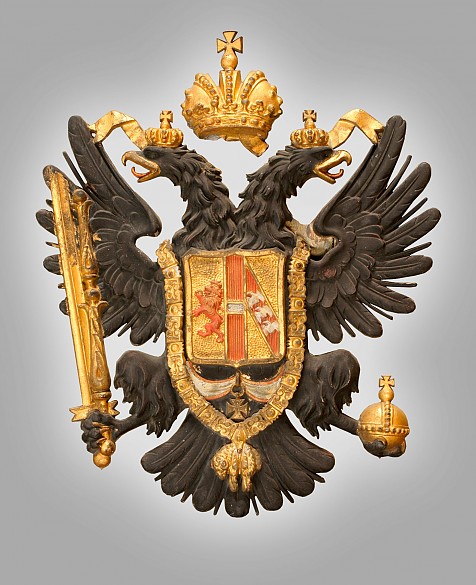
    What was the double eagle? J. F. Wagner was Austrian and the double eagle was actually an image common to the Austro-Hungarian coat of arms, illustrated below:

    Image credit: habsberger.net

    The image depicted the two headed eagle to represent the two halves of the Austro-Hungarian empire. It was not exclusive to the Austro-Hungarian double monarchy, since it was used centuries earlier by ancient cultures including the Roman Empire and was more recently used by Albania. It has appeared widely in national cultures, including on stamps of the countries, symbolic of courage, national unity and strength.

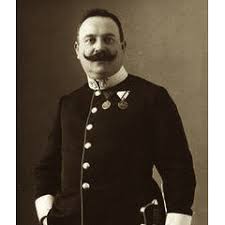
    Josef Franz Wagner was born in Vienna in 1856. His father was a doctor and Wagner received his basic musical education at the Royal Military Institute in Kaschau, Hungary. Around 1878 he was appointed bandmaster of the Royal 47th Infantry Regiment Band. Fourteen years later, he accepted a similar position with the 49th Infantry Regiment where he remained until his retirement seven years later, at least partly attributed to the fact that bandsmen had no pension benefits whereas military personnel were eligible for them. After his military retirement, Wagner was still in his 40s. He continued to compose and organized a civilian musical group. In addition, he is believed to have become popular as a conductor. Unfortunately he died at the age of 52 in 1908 of heart disease.

    During his lifetime, he is estimated to have written anywhere from 400 to 800 compositions, at least 250 of which are known to have been published. He composed his famous and perhaps most familiar (in the U. S.) march called Unter dem Doppeladler in 1893 and the music was published shortly thereafter.

    It has become a popular concert piece of concert bands. The Sousa band championed the work and accounts say it was recorded by Sousa three different times. It has since also become a popular crossover song in other genres and has been recorded and performed even by country music and bluegrass music artists.

    The march passes the bear test: On May 8, 1909, the Gazette (Cedar Rapids, Iowa) posted a humorous article about the playing of this piece on a Victrola-type record player for animals in the local zoo. The article stated the familiar adage that “music could soothe the savage beast” and listed several recordings that were played for the caged animals on the “talking machine” that had been placed on a borrowed orange crate. The first piece was a violin recording of a number by a Russian “with an unpronounceable name.” The two black bears, Bill and Gussie, seemed to like it. Then they played “Under the Double Eagle,” which the writer erroneously attributed to Sousa, the bears first retreated to their den before emerging again to walk around their cage, stopping on each circuit to listen to the music. Other pieces were played, including the “William Tell Overture,” ” Stars and Stripes Forever” and many slower numbers, but the bears seemed to prefer “Under the Double Eagle” best.


    J. F. Wagner’s Under the Double Eagle – YouTube

    , , ,

  • by Heritage Brass Band

    Image credit: @UTSA_Libraries

    This is a nice article about Texas’ Round Top Brass Band that includes some history of the genre in America.


    https://www.texaspolkanews.com/news/prost-round-top-brass-band-keeps-german-texas-beat

    ,

  • By Mike Magers

    Roland Forrest Seitz was born in 1867 in Pennsylvania to William and Magdalena Zeigler Seitz. His paternal grandparents had come to America from Germany just over 100 years earlier. Roland was the youngest of eight children. His father died when Roland was only three, and as a youth, Roland began working as an apprentice printer to help the family out, although he was always interested in music. A cousin had bought Roland a flute and he joined a family band of oddly mixed instruments including his flute, an organ, a trombone and some violins. A little later, Roland had learned to play the cornet and euphonium and played both in a group known as the Glen Rock Band.

    At the age of twenty-seven, Roland entered Dana’s Musical Institution in Warren, Ohio, graduating in 1898, after which he returned to Glen Rock, Pennsylvania. He rejoined the Glen Rock Band, eventually becoming its conductor. Seitz helped develop the band into a well known performing organization while he also founded his own music publishing company.

    Image credit: The Gazette and Daily, York, Pennsylvania, 4/27/1956

    As the caption in the above newspaper clipping states, the Glen Rock Band happened to be seated at the Pan-American Exposition held at Buffalo, New York on September 5, 1901 at the moment when President William McKinley was shot. The President suffered from the wound for a short time. After a brief rally, the President succumbed to complications from the gunshot wound about ten days later.

    His publishing company printed and marketed works by other well known period composers as well as his own works. At least one account has Seitz publishing a composition by composer/conductor Karl L. King when King was still a teenager. Seitz died on December 29, 1946 in Union County, New Jersey and he was buried at Chestnut Hill Cemetery in his home town of Glen Rock, Pennsylvania.

    Image credit – The Gazette and Daily, York, Pennsylvania, December 30, 1946

    Seitz is known to have composed over four dozen marches during his long career in music. One of his best known works, March Grandioso, or simply Grandioso, was composed in 1901. The march is based on a theme from Franz Lizst’s Hungarian Rhapsody #14 in F Minor. The now familiar march theme appears in the Lizst work in the allegro eroico, early in the piano score.


    Seitz – March Grandioso performed by the United States Navy Band (Youtube)

    Franz Lizst – Hungarian Rhapsody #14 in F Minor performed by György Cziffra (Youtube)


  • By Mike Magers

    Charles Edward Duble was a trombonist and composer born on September 13, 1884 in Jeffersonville, Indiana. During his performing career of over twenty years, he played with a number of circus, vaudeville and minstrel bands including the Sun Brothers Circus, John Robinson’s Big Ten Shows, Barnum and Bailey’s Greatest Show on Earth and the Ringling Brothers Barnum and Bailey Show, DeRue Brothers All-Star Minstrels and William F. Kibble’s Uncle Tom’s Cabin Company, among many others.

    Duble was described as a tall and lanky individual with a keen sense of humor, often given to practical jokes. He also was known to have a good memory, from which he recalled accounts of his career, organizations that he had been a part of, and the like.

    (Image believed to be in the public domain)

    His first composition is thought to be a march named “Floral City” (1905). Duble believed to have composed three to four dozen works in all. His best known composition is probably a march called “Bravura” (linked below).

    After his performing career ended, he returned to his home town of Jefferson, Indiana. He wrote many articles for Bandwagon, the Journal of the Circus Historical Society, many of which are available online. He died in August of 1960. His honors include being inducted in 1980 into the Hall of Fame of Windjammers Unlimited, the circus music historical society.


    Duble’s Bravura March (YouTube).

    ,

  • by Heritage Brass Band

    Joseph Shearin’s excellent article published in Windjammers Unlimited, Inc. – Circus Music Historical Society about the history of circus music.

    https://mywju.org/2020/05/circus-music-development/


  • (Posted with Permission)

    By Karl L. King (Extracted from a December 19, 1966 Interview with Karl King by Dr. Karl M. Holvik)

    Full interview posted in the June & October 1982 Circus Fanfares, available to Members at MYWJU.ORG

    This article published in the July-August 2020 Circus Fanfare

    Early Years

    I think I first became interested in band music when I was a boy in Canton, Ohio, President McKinley’s home.  This was about the turn of the century — about the time of the Spanish-American War.  There were quite a lot of parades and celebrations around there with a lot of marching bands.   I was rather taken in by all these parades and military extravaganzas. 

    The only way a young fellow could get into a band in those days was to take lessons from some private teacher and try to work his way into an adult organization such as the town band of that period.  It wasn’t easy because you would go among those older players and they would ignore you or push you around a bit before you could “cut the giblets”.

    I bought my first cornet when I was selling papers on the street.  It took all the money I made selling papers to make the payments on the cornet, and I had to take private lessons and dig up the money for those, too.  I was eleven or twelve years old.  The local bandmaster was Mr. Foster of the Thayer Band.  I was taking lessons from him, and he thought I’d do a little better on the baritone;  this was a smart idea, because it was a better instrument for me. 

    My first playing was as a baritone player with the Thayer Band at Canton.  They had two bands there, the Thayer Band and the Grand Army Band,  No school bands at all.  If you wanted to play, you had to get into an older band.   I had to buy my own instrument.  I had to pay for my own private lessons and take my own chances.  I was working in the printing office there at the time, and I was trying to write music without knowing how or why — just interested in band music and determined to do something with it.

    I went down to Columbus and played with Fred Nettermeyer’s Band.  I remember I played the Ohio State Fair job with them.  That was probably my first professional playing.   

    Circus Time

    I was sort of undecided about whether to keep on following that printing career or become a professional musician.  I had a chance to join the Robinson Circus as a baritone player, so that ended my career as a printer.

     I was about 18 years old when I joined the Robinson Circus Band.  I didn’t finish high school — I didn’t even go to high school.  I’m probably the most uneducated member of the American Bandmasters Association. 

    I went on to the Yankee-Robinson Circus the next year, playing baritone.  Then on Sells-Floto; then on Barnum and Bailey in 1913.

    Barnum and Bailey’s Favorite (1913)

    I was going on the Barnum and Bailey Circus to play baritone for Ned Brill, and he asked me to write a special march for them — which I did, and which I dedicated to him.  It was just one of those things. 

    I’ve always loved the baritone.  I always thought it was not only the cello of the band but the soul of the band, too.  I liked to hear the baritone romping around there, and I’ve always tried to write good parts for that instrument.  I just loved the instrument. 

    In 1914 I became the conductor of my own band; that was the combined Sells-Floto and Buffalo Bill’s Circus Band. 

    World War 1 started in ‘14, but we didn’t get involved in it until ‘17.  At that time I was directing the Barnum and Bailey Band and, somehow or other, I managed to escape the draft during the 1917-18 season. 

    But, at the close of the ‘18 season, I was all ready to go into the Army.   After taking two physical exams I was inducted; in fact, I had my orders to leave for Camp Grant, Rockford, Illinois.  I was to direct the band at an officer training school there.  Just as I was ready to leave, the war ended.  So I never really got a chance to get into the Service.

    Life after the Circus

    I didn’t go back (to the circus) after 1918.  I wanted to get into something where I would have a little more time to study and write.  So I stayed in Canton, Ohio and conducted the Grand Army Band.  Then this job in Fort Dodge, Iowa opened up.  They were looking for a director in 1920.  I came out not intending, particularly, to stay (for now 46 years!) 

    I’ve been working on that first one-year contract all this time.  Somebody forgot to fire me, I guess. 

    (As to writing my first march), I don’t even remember for sure what the first ones were.  I know the first several things I wrote were rejected by most of the publishers, and it’s a good thing, probably, because I don’t have them around here to haunt me now.  But I had some music published back in 1909 by Seitz in Glenrock, Pennsylvania; then by the Barnhouse people in Oskaloosa, Iowa.   I wrote experimentally.  I had no formal training in harmony or counterpoint.  I studied a few books in that line, but progress was slow.  To my way of thinking, it was easier for me just to sit down and write the thing and try it over on the piano to see if it sounded right than it was to fool around with all those rules and exceptions.

    I must have just written by instinct and, of course, I did study the scores and the writing of all the good band writers that I could come across.   I learned my instrumentation that way — by seeing how the other men wrote for these various instruments, and I knew, of course, the range and possibilities and limitations of the instruments through a fair amount of experimentation and by playing them somewhat. 

    I have learned in composition or conducting mostly by imitation, by experimentation, and by listening to good men and watching good men.  I think that’s one of the best ways of getting an education. 

    On the circus I got a lot of inspiration.  I did a lot of writing and arranging for different acts.  They wanted a certain type of music; that’s where a lot of these things came from.  An act would come on and need something special, like a Spanish number or a Chinese number or something else.  Naturally, I’d write something for them, and then in the following year I’d put a title on it and get it printed in order to get a few dollars out of it.  About half of the things I wrote in those first years were written directly for the circus — certain acts, certain situations or performers.

    Karl King Music House

    I started that in Canton, Ohio, publishing a few marches and things.  I had a few things published in my own catalog before I moved (to Fort Dodge, IA).   It’s a wonderful place to have been these years.  There’s one thing I still believe:  Iowa’s the greatest band state in the Union.  The support they’ve given our municipal bands by means of the Iowa Band Law — through all of those years!  Iowa was probably the only place I could have conducted this type of band and kept it in continued existence.  The public has been so nice and so receptive to the band and its work.  They’ve been so gracious to me that I wouldn’t have wanted to move from here — Fort Dodge in particular and Iowa in general.  It has been a very fine state, and with a good attitude toward bands and band music.  People out here love bands.  And because they love band music, I love them too.  We’ve had sort of a romance between the public and the bands.   There is a Sousa bridge in Washington (DC) and I don’t imagine he’d resent the fact that I have one in Fort Dodge. 

    John Philip Sousa

    To me the Sousa Band was always the greatest.  Of course, it’s so long ago that it’s hard to make comparisons, but I haven’t heard any band since that I thought sounded any finer than his band when it was at its best.

    The Sousa Band went out all over the land and played good music for people who had very little chance to hear it elsewhere, before the days of radio or TV or anything of that kind.  Even the record industry wasn’t greatly developed at that time, and for a lot of people, the only good music they ever heard was when the Sousa Band came through on tour.

    It was an institution and, of course, there’ll never be anything like it again.  It would be impossible, economically, to take a band of that size and quality on the road anymore.  The expense would be so terrific, and there are so many things to conflict.  No man could do what he did:  take that band on three or four world tours; support them entirely without any sponsorship or financial aid from anyone else.  Money had to come into the ticket office, or he couldn’t have done it.   It was due entirely to his showmanship and his personal ability — a great man.

    I was always a great hero-worshipper.  Sousa was one of my heroes; so was Herbert Clarke, who I think was the greatest cornet soloist who ever lived;  Arthur Pryor, the greatest trombonist;  Simon Mantia on baritone.   Incidentally, at one time they were all soloists with the Sousa Band; they were the outstanding bandmen of that era and I always looked up to them and still do.  They were pioneers in this game. 

    Many of us — Henry Fillmore and Herman Bellstedt, who did so much arranging for Sousa, and others — had to write things, and we had to write them in a hurry, especially when we were with a show.  We’d write a lead sheet, a solo cornet part, and take off from that.  You’d just write the parts without writing the score.  Oh, we’d have something of a mental score.  You knew what chord you were going to use, and you knew about what you were going to do with this instrument or that one.  But we’d just start with the lead part and write from that.   An embarrassing thing:  In the last thiry or forty years I’ve had to go back and write conductor’s parts for marches I wrote fifty years ago without a score and do the whole thing in reverse — write a score from the parts, rather than the other way. 

    Herman Bellstedt, (who) used to write those novelty things for Sousa, would write a cornet part and stick it up on the mantle, and then write a clarinet part and stick it up beside it, and go around the room until he had them all written.  The next day he would have the arrangement done; if he’d had to score it all, he’d have had to write it all twice — the score and the parts.  It was a case of getting it done quickly.  I don’t recommend this to anyone today.  They’d just get confused and all the professors would throw up their hands in horror.

    School Band Movement

    The school band movement was almost full-grown before I became conscious of it.  I remember my first contact with it came in the days of the national contests.  I judged some of those; I judged at one of the first ones … I think that was at Tulsa.  Mr. Sousa was one of the judges there; and Goldman.   The movement has done some tremendous things, and there are some very outstanding school bands.  The university bands are getting better all the time. 

    Things have happened so fast I can hardly keep track of them.  I know a few years ago, when I was very active in conducting massed bands they got to be so tremendous I could hardly conceive of them.  In 1960 I went to Houston to do one with 7,500 players; then I went to Purdue and had 10,000; then to Ann Arbor with Revelli, and he trotted out 13,000. 

    Modern Music

    There’s a lot of the more modern, contemporary music.  I’m not quite as sold on it as some other folks, but that’s probably due to the fact I belong about three generations back.  There are a lot of things being featured and promoted today in the way of contemporary music that would not be suitable for my programs for the simple reason the public out there in the park wouldn’t react too well to them; they just wouldn’t appreciate them.   I play the traditional things like marches and musical show tunes. 

    I think the (current) bands are missing quite a bit by turning their backs completely on the old repertoire, the traditional type of band music.  I don’t think they ought to lose sight of the real reason for bands.  The very first bands that were ever organized were small, military-type organizations, and their original purpose was morale-raising; that’s why they were created; probably to raise the morale of the marching men, the soldiers.  But in this troubled period we’re in today, everybody, not just the military, needs his morale lifted a bit.  (It’s a) crazy world we’re living in now.

    You can’t listen to a really fine band playing the Stars and Stripes Forever and still have your chin down.  I think we should take up again that activity of trying to raise the morale of people by playing inspiring, uplifting , and cheerful music.   After all, I don’t see anything wrong with pretty music.  And if there is anything lacking in some of our latter-day things, it’s a lack of melodic content and a lack of emotional content.  I think that music should say something.  I have always thought that it should sing out a bit.  I don’t think a man should sit down to write unless he’s got a song in his heart. 

    Now, I sang my song.  It was a rather simple one; it wasn’t too involved; I’m happy about it.   In the last couple of years people have asked me why I’m not writing anymore, and my simple answer is that I ran out of tunes.  When I ran out of tunes, I believed it was time to quit, and I’d like to recommend that as a matter of policy to all other composers.
    ,

  • By Mike Magers

    Like so many other band composers, Julius Fučik was born into a musical family in Prague, Czechoslovakia (then known as Bohemia) in 1872. His principal instrument was bassoon and he studied composition under Antonin Dvorák. Fučik joined a regimental Austro-Hungarian band while he was in his late teens and played with the group until he was in his 20s. He then returned to Prague and then on to Agram where he began play with the New German Theater Orchestra and is known to have composed trio music for a small wind group he co-founded. He also began conducting area groups.

    Fučik rejoined the military in 1897 when he became conductor of the 86th Infantry Regimental Band in Sarajevo, Yugoslavia. While there he continued to compose, including his familiar “Entry of the Gladiators” which is more commonly associated with circus music here in America. It is also known in the United States as “Thunder and Blazes.” Fučik continued to conduct military bands until his retirement around 1913. He married and moved to Berlin where he continued to conduct and compose. However he was taken ill in Berlin and died in 1916 at the age of 44 of an unknown illness. He is buried in Vinohrady Cemetery in Prague.

    In all, he is known to have composed over 400 works, with “Entry of the Gladiators” and “Florentiner” perhaps being the most familiar to American listeners.


    Two examples of Fučik’s work: Entry of the Gladiators (YouTube) and Florentiner (YouTube).

    ,