Category: conductors


  • John Philip Sousa, known as the March King was in North Texas at the Denton, Texas College of Industrial Arts, an all female school now known as Texas Woman’s University. The famous conductor had come to the area in the fall of 1928 as part of his Golden Jubilee Tour and scheduled two concerts at the college in Denton. After one of the performances, Sousa was presented with a petition signed by 1,700 the students requesting that he compose a march just for them. Sousa agreed and asked the students to suggest names for the musical piece. As far as we know, he received no suggestions for the name but composed the march we now know as “Daughters of Texas.”

    Another wrinkle in the story is as follows. Sousa was nearing the end of his long career and he was also asked by Minnesota businessman Wilbur B. Foshay to bring his band to Minneapolis in 1929. The occasion was to be a four day celebration that would include the dedication of a structure to be known as the Foshay Tower. It was an office building that was to somewhat resemble the Washington Monument.

    Various accounts note that Sousa was in the process of composing his march for the Denton college but in the interest of time, he reportedly adapted his work in progress and used it for the Minnesota celebration. That piece was renamed the “Foshay Tower Washington Memorial March” and was performed there but never published. Sousa then composed a different march for the Denton school. Supposedly, early copies of both marches still exist in some form. The Minnesota trip took place and and the the Foshay Tower was dedicated. Now almost 100 years old, it still stands in Minneapolis today and is currently operated as a hotel.

    The Brattleboro Reformer,
    Brattleboro, VT, March 20, 1929

    The Denton Record-Chronicle reported that the new march named “Daughters of Texas” had been completed in the summer of 1929. The article below from the same newspaper notes that the first copies of the march were delivered to the College of Industrial Arts (C. I. A.) the following year.

    Denton Record-Chronicle,
    Denton, TX, April 29, 1930

    United States Marine Band playing “Daughters of Texas” (YouTube)


  • by Heritage Brass Band

    John Philip Sousa, the renowned American composer and conductor known as the “March King,” died on March 6, 1932, in Reading, Pennsylvania. He passed away at the age of 77 from heart failure while staying at the Abraham Lincoln Hotel. The great conductor had lead a rehearsal with the Ringgold Band earlier that day and died in his sleep that night. His body was taken to Washington, D.C., where a funeral was held at St. Agnes Church, followed by burial at Congressional Cemetery on March 10, 1932.

    Clippings from the Reading (Pennsylvania) Times, 3/7/1932

    , , ,

  • by Heritage Brass Band

    Over the years, the band has played a lot of Stephen Foster compositions and has also recorded a CD called The Unknown Stephen Foster of only his songs. Please enjoy this biography of the wonderful American composer Stephen Foster.

    Image credit – Discogs.com

    , ,

  • By Mike Magers

    Wagner was the composer of a well known march called “Under the Double Eagle” in 1893. It has been so often performed by United States bands over the years that it could easily be mistaken to be an American patriotic work.

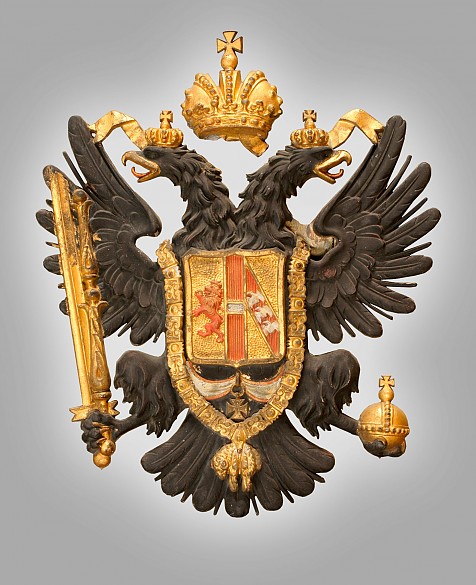
    What was the double eagle? J. F. Wagner was Austrian and the double eagle was actually an image common to the Austro-Hungarian coat of arms, illustrated below:

    Image credit: habsberger.net

    The image depicted the two headed eagle to represent the two halves of the Austro-Hungarian empire. It was not exclusive to the Austro-Hungarian double monarchy, since it was used centuries earlier by ancient cultures including the Roman Empire and was more recently used by Albania. It has appeared widely in national cultures, including on stamps of the countries, symbolic of courage, national unity and strength.

    Josef Franz Wagner was born in Vienna in 1856. His father was a doctor and Wagner received his basic musical education at the Royal Military Institute in Kaschau, Hungary. Around 1878 he was appointed bandmaster of the Royal 47th Infantry Regiment Band. Fourteen years later, he accepted a similar position with the 49th Infantry Regiment where he remained until his retirement seven years later, at least partly attributed to the fact that bandsmen had no pension benefits whereas military personnel were eligible for them. After his military retirement, Wagner was still in his 40s. He continued to compose and organized a civilian musical group. In addition, he is believed to have become popular as a conductor. Unfortunately he died at the age of 52 in 1908 of heart disease.

    During his lifetime, he is estimated to have written anywhere from 400 to 800 compositions, at least 250 of which are known to have been published. He composed his famous and perhaps most familiar (in the U. S.) march called Unter dem Doppeladler in 1893 and the music was published shortly thereafter.

    It has become a popular concert piece of concert bands. The Sousa band championed the work and accounts say it was recorded by Sousa three different times. It has since also become a popular crossover song in other genres and has been recorded and performed even by country music and bluegrass music artists.

    The march passes the bear test: On May 8, 1909, the Gazette (Cedar Rapids, Iowa) posted a humorous article about the playing of this piece on a Victrola-type record player for animals in the local zoo. The article stated the familiar adage that “music could soothe the savage beast” and listed several recordings that were played for the caged animals on the “talking machine” that had been placed on a borrowed orange crate. The first piece was a violin recording of a number by a Russian “with an unpronounceable name.” The two black bears, Bill and Gussie, seemed to like it. Then they played “Under the Double Eagle,” which the writer erroneously attributed to Sousa, the bears first retreated to their den before emerging again to walk around their cage, stopping on each circuit to listen to the music. Other pieces were played, including the “William Tell Overture,” ” Stars and Stripes Forever” and many slower numbers, but the bears seemed to prefer “Under the Double Eagle” best.


    J. F. Wagner’s Under the Double Eagle – YouTube

    , , ,

  • By Mike Magers

    A. Clyde Roller (1914-2005) was a music professor, conductor and clinician. His primary personal instrument was oboe. Dr. Roller was a well known and requested clinician in the southwest, while he lived in Amarillo, Texas, but he also had a national reputation. While living in the Panhandle of Texas, he conducted youth ensembles for several decades, being asked to conduct at band/orchestra camps and all-state/all-region orchestras.

    Dr. Roller was born in Rogersville, Missouri and after his high school education received further musical education at the Eastman School of Music where he graduated in 1941. As a performer, he served as principal oboist in the Oklahoma City Symphony, the Birmingham Alabama Symphony and the Tulsa Philharmonic.

    He then conducted the Southern Methodist University orchestra in 1947 and 1948 and from 1948 until 1962, Dr. Roller conducted the Amarillo Symphony Orchestra. During this period, he accepted various other assignments as guest conductor, including the Boston Symphony Orchestra.

    The following year, he returned to Eastman, where he served as ensembles professor. He also conducted the Eastman Wind Ensemble from 1964 to 1966. He later went on to serve in similar capacities at University of Houston, University of Texas, Southern Methodist University, University of Wisconsin at Madison and University of Michigan. For over fifty years, he also was an oboe instructor and conductor at the Interlochen Center for the Arts.

    Dr. Roller also was the resident conductor of the Houston Symphony Orchestra, and the musical director and conductor of the Lansing Michigan Symphony Orchestra from the mid 1960s to the late 1970s while accepting guest recording and conducting assignments in the United States and abroad.

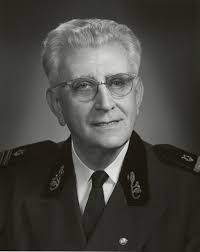
    (Image credit: Amarillo.com)

    As mentioned above, Dr. Roller was regularly asked to conduct youth educational honor groups. Over the years, he participated as conductor in almost every state, including all-state orchestras, region orchestras, string festivals and the like. It would not be unusual for him to have conducted the children of students that he had conducted in other ensembles many years earlier.

    During his long career, Dr. Roller received many honors, including the Amarillo “Man of the Year” Award, Texas Orchestra Director of the Year (1979), Sigma Alpha Iota’s National Artist Affiliate Award (1979), and the Outstanding Educator of America Award. In 1998, he was awarded the Edwin Franko Goldman Memorial Citation by the American Bandmasters Association, “In Recognition of Distinguished Contributions in the Interests of Bands and Band Music in America.” In 1981, Dr. Roller was honored with the Eastman School’s Alumni Achievement Award.


  • By Mike Magers

    Karl Lawrence King was one of the most prolific composers of American marching band music, penning almost 300 works. He was born in Paintersville, Ohio in 1891. The story is told that at age eleven, Karl bought a cornet with money he had earned selling newspapers. By that time, his family had moved to Canton, Ohio and he had been taking cornet lessons for a few years. King soon switched to trombone and euphonium and joined a youth band known as the Canton Marine Band. He was not formally trained in music, actually had little schooling at all, and learned musical composition on his own. By his late teens, King was supporting himself playing in local bands and circus bands. When King was in his early twenties, he had already performed and conducted a number of bands and was writing his own music.

    He married the former Ruth Lovett in 1916 and three years later the couple had their son, Karl L. King, Jr. Ruth was a keyboard player and they had reportedly met while she was working as a calliope player in Barnum and Bailey’s circus band. The young family relocated to Canton, Ohio where Karl started his own music publishing company. They moved to Fort Dodge, Iowa in 1920 and would be based there for the rest of Karl’s career. King served as conductor of the Fort Dodge Municipal Band for fifty-one years. The band became very well known, had a radio program on station WHO in Des Moines, Iowa and played at almost every Iowa State Fair beginning in 1920.

    During his life, King composed many different styles of music in addition to marches, including overtures, intermezzos, galops, waltzes, rags and serenades while Ruth operated a business selling musical instruments.

    Many of his pieces were composed during his years with circus bands, or were reminiscent of the circus band genre. He also composed works for universities of the old Big Ten Conference. One of his most famous works, “Barnum and Bailey’s Favorite” was also one of his earliest works, composed in 1913. Other familiar compositions included “Emblem of Freedom.” “The Big Cage,” “Cyrus the Great,” “Pride of the Illini” and many others.

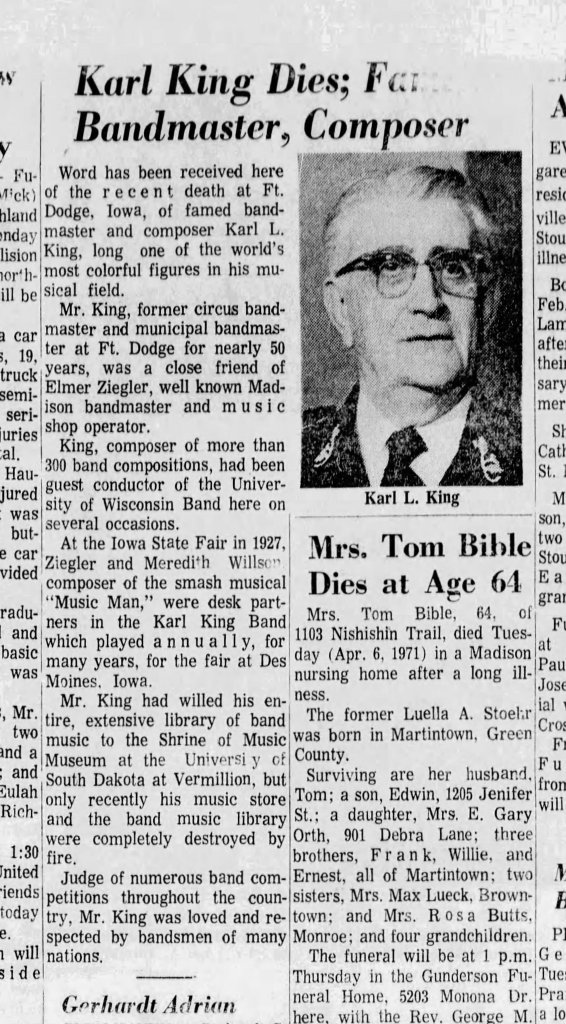
    The great composer died in late March, 1971. Ruth survived him until 1988 and both are buried in the North Lawn Cemetery in Fort Dodge. As a tribute to them both, Ruth’s epitaph reads as follows, “A matchless queen to keep him company. Truly a royal family.”

    (King’s obituary in The Capital Times, Madison, Wisconsin, 7 April 1971.)


    An example of King’s work: Barnum and Bailey’s Favorite (Youtube).

    , ,

  • By Mike Magers

    Carmen Dragon was a noted composer, arranger and conductor. He was born July 28, 1914 in Antioch, California to a family of Italian heritage. He died in Los Angeles on March 28, 1984. According to his obituary in the New York Times, by his teens he had learned to play the piano, string bass, accordion, trumpet and trombone. He went to elementary and high school in Antioch and attended San Jose College.

    He began composing even before he went to college. The Oakland Tribune article from February 18, 1930, shown below, mentions a composition of his called “Forward, Antioch!” that was to be performed by his high school orchestra, although it erroneously refers to Dragon as being a high school girl.

    An arrangement he did came to the attention of Meredith Willson, who would go on to compose such musicals as “The Music Man” and “Unsinkable Molly Brown.” Willson introduced Dragon to the film business. By the 1950s, Dragon had been working in films, composing and arranging for over a decade. He shared an Academy Award in 1944 with Morris Stoloff for their work on the musical “Cover Girl” staring Rita Hayworth and Gene Kelly. He had also begun to work heavily in radio and served as the musical director for a number of programs.

    Dragon was an early conductor of one of the orchestras that went by the names Hollywood Bowl Orchestra and Hollywood Bowl Symphony Orchestra. Generally staffed from the large pool of studio musicians in the area, the groups have been known for giving pops-style concerts in the Hollywood Bowl venue. Dragon conducted the group for ten years. While he was conductor, the orchestra performed on a radio broadcast known as the Standard School Broadcast. Funded by the Standard Oil Company (now Chevron), these programs were geared to introduce young students to music and American history. Dragon also hosted a regular program of classical music for the Armed Forces Network, now known as the American Forces Network.

    Over the years, he conducted over four dozen recordings of orchestras with which he was associated, including the Hollywood Bowl Orchestra, the Capitol Symphony Orchestra, the Royal Philharmonic Orchestra and the BBC Symphony Orchestra.

    Dragon died of cancer after being hospitalized at St. John’s Hospital in Santa Monica, California. He was survived by his wife and five children, several of whom were musicians.

    Some of his arrangements are available on his website, carmendragon.com.

    His arrangement of “America the Beautiful” has become a standard performance piece for bands, choirs and orchestras across the country. Dragon did a number of arrangements of this familiar patriotic piece, including one for full orchestra and another for choir and orchestra. The concert band arrangement was debuted an a music conference in Ohio in 1960, conducted by Dragon himself, and performed by the Ohio State University concert band. This particular arrangement was published in 1963. Fortunately, the 1960 concert band performance was recorded, preserved and is available in the link below.


    “America the Beautiful” – Youtube.

    , ,

  • By Mike Magers

    Claudio Grafulla was born in 1810 (some sources say 1812) on the island of Minorca, a Mediterranean possession of Spain. He was a french horn player and moved to the United States when he was twenty-eight years old. Living in New York, he was a member of Napier Lothier’s Band, part of the 7th Regiment of the 107th Infantry of the New York National Guard. Grafulla became better known as a composer, arranger and conductor and he later served as the conductor of the band. One of its performance highlights was the occasion Grafulla and his band performed at Ford’s Theater in Washington, D. C. on December 8, 1864 for an audience that included President Abraham Lincoln. President Lincoln was assassinated in April of 1865.

    Though Grafulla was recognized as an arranger, he composed many different works in a number of different styles, including marches, waltzes, schottisches and galops. Some of his best known works are Washington Grays (also known as Washington Greys), Freischütz Quickstep, Captain Shepherd’s Quickstep, Captain Smith’s Quickstep and Big Thunder.

    Quoting his Findagrave entry, “Grafulla composed Washington Greys in 1861 for the 8th Regiment, New York State Militia. This work has been called a march masterpiece, a band classic, and the prototype of the concert march. Showing the stylistic influence of both German and Italian marches, the march has a marvelous balance of technique and melody in a continuous flow of musical ideas. It dared to break the old formulas, however, because it has no introduction, no break strain, and no stinger.”

    (Grafulla’s funeral, as reported in the Chicago Tribune, December 9, 1880)

    Grafulla never married and it has been said that he lived for his music. Upon his death in 1880, he was buried in Green-Wood Cemetery, Brooklyn, New York.


    An example of Grafulla’s work: Washington Grays (Youtube).

    , ,

  • By Mike Magers

    “Boy Soprano Cared More for Cave Than Warbling for Sousa”

    This was a headline in the Fort Worth Star Telegram, December 24, 1925. The great band leader had come to the Panhandle to do a concert. Thirteen year old “Balie” (actually spelled Bailey) Warren had been invited to sing for the Sousa Band over the initial objections of John Phillip Sousa, who had said that the band carried its own soloist. Sousa relented and young Bailey was asked to sing.

    The article related that the boy was well known in the area as a soloist and came to sing with the band, but that he had been anxious to get back to a cave that he and his pals were digging in his back yard. Young Bailey was typically fearless before a crowd and did well that day, but at the end of the concert, he took off for home to return to his friends and the cave they were digging.

    “Good night,” he exclaimed, disgustedly: “that’s the way it always goes when I am trying to do something. The kids have gone home, and we can’t finish the cave until tomorrow,” the article concluded, quoting Bailey.

    The 1930 Census showed that the 17 year old Bailey was living with his parents and working at a radio station in Amarillo. It’s thought that the family then moved to California. In the 1940 Census, Bailey was still living in California in that report, he listed his occupation as singer and entertainer. Bailey apparently went on to have a career in the radio-television business.


    , , ,

  • By Mike Magers

    Composer Henry Fillmore was born December 3, 1881 in Cincinnati, Ohio. His father was James Henry Fillmore, a composer of gospel songs. Henry was something of a musical prodigy and as a youth, he learned to play the piano, guitar, violin, flute and trombone, which incidentally became his favored instrument. He was educated at the Cincinnati Conservatory of Music.

    During his long career Fillmore was a composer, band leader, music publisher among his many other interests. He was a prolific composer, penning 250 or more works. Not wanting to flood the market with compositions in his name, he published under pseudonyms including Harold Bennett, Al Hays, Harry Hartley and Ray Hall, among others. He is widely recognized as one of the “March Kings” of that genre.

    Some of his best known compositions are: The Footlifter, Americans We, The President’s March, The Klaxon, Lassus Trombone, The Circus Bee. Many of his popular works were written as pieces to feature his favored instrument, the trombone.

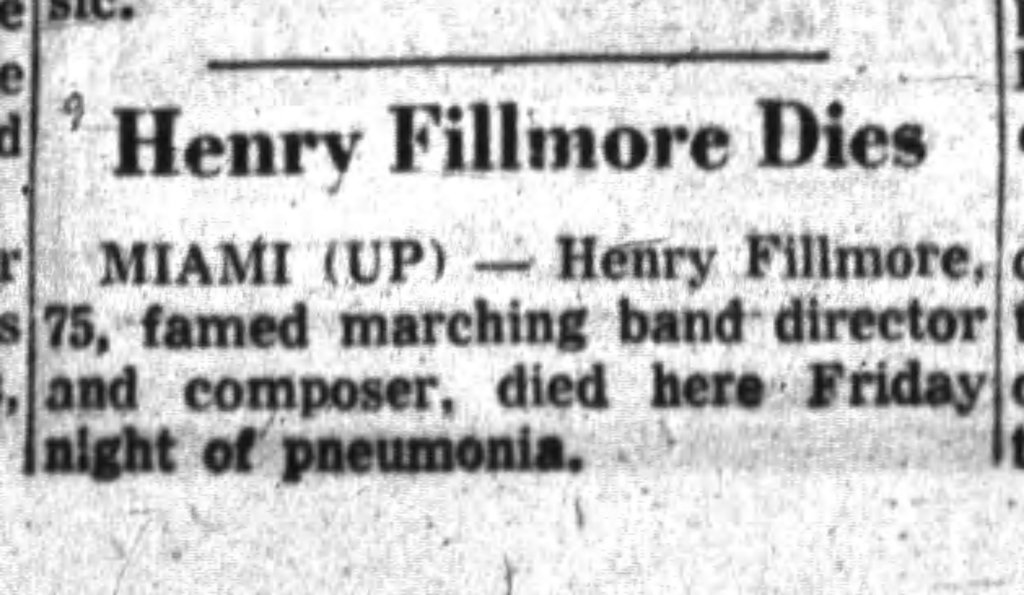
    Fillmore died in 1956 in Miami, Florida at age 75.

    (Fillmore’s death, reported by The Anniston Star, Anniston, Alabama. 8 Dec 1956.)


    An example of Fillmore’s work: The Footlifter – Youtube

    ,