Category: history


  • By Larry Johnson

    At any Civil War re-enactment, participants can readily be found who are knowledgeable of weapons, uniforms, and equipment of the period. Most infantry re-enactors can discuss the difference between Enfield and Springfield rifles, and those who do cavalry impressions can competently compare Sharps and Spencer carbines. There are even artillerists who have sorted out the various throw-weight, diameter, and caliber nomenclatures of guns well enough to make sense of the subject. Medical impressions are also generally well done because they are often presented by actual physicians who are professionally trained and know their subject. Civilian portrayals, on the other hand, sometimes go astray. An 1870’s Western gunfighter, for example, is an anomaly on an Eastern theater Civil War field. So is a California gold miner, yet such things are seen.

    However, the most problematic presentations at most re-enactments are musical performances. These are often given by amateurs and hobbyists who are not schooled in music and lack adequate knowledge of the styles, repertory, literature, and performance practices of the period. Almost anything can be hem:d at re-enactments, little of which is truly authentic. (To wit: “Ashokan Farewell,” composed in 1986, is quite popular but definitely not authentic.) For the next few paragraphs, we shall discuss what would have been heard on a Civil War field, as well as what was not there.

    In the 1860’s, there was either live music or none. There were no boom boxes, mp3 players, cell phones, or any mechanical reproduction devices. Neither was there any such thing as electronic amplification. The only music available was provided by the military bands or it was made by the soldiers themselves. And here is where so many sins are committed at re-enactments.

    Camp music, which was made by soldiers when in camp, consisted primarily of group singing without accompaniment. Usually, one soldier with a strong voice led and the others joined. What few instruments that were present in the encampments were small, light, and portable enough that the soldiers could carry them while on the march. The most common instrument by far was the fiddle, which was present in large numbers in both armies. Second to the fiddle in popularity, and a distant second at that, was the wooden or folk flute. Other instruments included the concertina (squeeze box), harmonica, jaw’s harp, ocarina, and the banjo. Various percussion instruments, especially bones, were improvised.

    Contrary to its popularity at modern re-enactments, the guitar was not present in period camps. For one thing, it was too large and bulky to be carried. For another, the guitar was not a popular instrument at that time and not very many people played it. Period photos do reveal guitars present at fixed installations such as heavy artillery forts and supply depots where the soldiers were stationary rather than actively campaigning. Guitars were also found one here and one there aboard ships. When seen, guitars appear in the photos as isolated, single instruments – never in multiples. But there is scant if any evidence that guitars were ever found in a period infantry encampment.

    Whenever a re-enactment is being planned, an individual or committee is charged with selecting music for the event. This person may be a seasoned re-enactor, but in nearly every case, he has no knowledge of period music. In such circumstances, the results are always the same: the person in charge of music will select music he personally likes. Since Country and Western music is popular among re-enactors, the band most likely to be engaged to perform at events, particularly at dances, is one that sounds like a Country and Western band. While this style of music may be popular, it is anything but authentic.

    Country and Western music originated in the 1930’s and with it came the idea of guitar bands. Prior to that time, guitars were used almost exclusively as single instruments to accompany singers. Civil War Era string bands, which were small, consisted of fiddles often supplemented by a flute. A cornet might also have been included. The tenor banjo, which was deeper sounding than the modern version, made frequent appearances as well. But guitars did not. Guitar bands, so common today, did not exist in the 1860’s.

    The documentation for the composition of the period string bands comes from a collection of instrumental music written by none other than Stephen Foster and published by Firth, Pond, and Co. in 1854. This work, which was titled The Social Orchestra, was a compilation of pieces written for the ensemble which was in use at that time to play for social events (dances). Its instrumentation was a flute, two violins, and a bass instrument, preferably a cello. Foster wrote and arranged numerous pieces for this four part period dance band, then added others for three instruments. He went on to include duets for two players and finally solos for one instrument, which were obviously intended for single fiddle. All of these pieces could be used for dancing, even the solos, and indeed Mary Boykin Chestnut mentions balls accompanied by a single fiddler.

    Corroboration  of the widespread use of the fiddle-flute combination lies in a notebook of sketches drawn by Confederate John Omenhausser while a P.O.W. at Point Lookout. One panel depicts prisoners staging a variety show accompanied by their ad hoc orchestra of flute, two fiddles, and a banjo. Attached was an improvised period percussion section of a tambourine, triangle, and the ubiquitous bones. The drum set, which developed concurrently  with silent movies, was unknown in the 19th Century and should be neither seen nor heard at a re­ enactment.

    Thus far, we have shown that Civil War instrumental music relied on the fiddle as the primary instrument and that guitars were little used. Now, we shall take up the case of vocal music.

    In the 19th Century, singers had to sing. Amplification was not available in those days and thin, breathy voices never made it to the concert stage. Successful singers were those whose who had studied with a voice teacher and had learned to project the voice. They could fill a concert hall with sound and be heard without microphones and speakers. When Jenny Lind toured the United States in 1850, she was booked into the largest venues available – auditoriums, concert halls, churches – and drew capacity crowds wherever she performed. In some instances, windows were opened so people who couldn’t get tickets could stand outside and hear her. And they could. Patrick Gilmore staged his monster National Peace Jubilee concerts in 1869 for which a special pavilion was constructed that housed 11,000 performers and an audience of nearly 40,000. He engaged a renowned European soprano named Madame Parepa-Rosa to sing at the event and contemporary accounts attest that her voice was equal to the challenge. Only Gilmore could upstage Gilmore and, in 1872, he produced his even larger World Peace Jubilee. This time, the coliseum housed nearly 100,000 performers and listeners. Several vocal soloists, including American Clara Louise Kellogg, were featured. They were heard, though faintly, in even the farthest seats. And all of this was several decades before the development of amplification technology.

    Granted, there was far less noise pollution in those days and audiences were much better mannered than they are today. But singers still had to project their voices and only those who had been trained could succeed in any venue larger than that domain of amateurs, the parlor. Yet, re-enactments persist in featuring amateur vocalists singing “old”songs into a microphone and not to the audience.

    “Old songs”- therein lies another problem. A quick glance at a song’s publication date will cut to the core of this issue in a hurry. Far too often, amateur singers who have done no research plug in their microphones, twang their guitars, and sing, what to them, are old songs; some of which date back as far as the 1920’s. Other performers draw material from movies, television, and recordings. The folly of that approach should be obvious, but apparently, it isn’t. One hears music from the folk revival of the 1960’s, old hits by the Sons of the Pioneers, and songs recorded by Bobby Horton, et al, being passed off as period. Some of these tunes actually are authentic, but care should be taken with the texts. Numerous songs became obsolete when the war ended and their words were altered or replaced entirely with the passage of time. (Aura Lee/Love Me Tender). Thus, before a singer performs what he thinks is period music, he should first research both the publication dates and the original texts.

    And now, a special word of caution pertaining to hymns. As a general rule, the hymn writer composes only a poem; the tune comes from a variety of sources. One of these is preexisting melodies to which the poem was written to fit or with which it was eventually matched. But one must be discreet when selecting old hymns with tunes whose sources are not documented because some of these tunes have unholy pasts. To be candid, many were originally bawdy songs. Songs in this category flourished during Colonial times, thanks to the British, and their melodies were well known, especially in the taverns. One of them, Anacreon in Heaven, became our National Anthem. Many others wound up as hymn tunes and are still in use. Therefore, one should be wary of performing hymns whose tunes have vague origins because the words sung to those tunes in the 1860’s may have been, shall we say, “inappropriate for polite company.”

    In recent years, there has been a proliferation of bagpipes at re-enactments. When questioned, the pipers invariably reply they “just know” that there were pipers among the Scottish and Irish troops. That statement is true. There were, in fact, soldiers who could play the bagpipes within various regiments of both armies. But they did not have their instruments with them. Bagpipes were not part of the American military traditions and American soldiers had no appreciation for them. Besides that, pipes were valuable. Some of them had been presentation pieces and/or family heirlooms, and the silver fittings which came with the more expensive sets of pipes made them a tempting target for thieves. In an environment that left bagpipers no role to play within a soldiery that had no regard for .pipes, pipers chose to leave their instruments at home rather than risk them being damaged or stolen.

    The author of this article has been reading Civil War history {with an eye towards references to music) since the 1950’s and in more than fifty years, he has seen bagpipes mentioned exactly once. That one case involved the 79th New York. This was an early war short-term regiment formed from Scottish immigrants who wore bonnets, doublets, and kilts imported from Scotland. The 79th had pipes and frequently paraded with them. They fought one battle, First Manassas, (wearing ordinary blue uniforms at the time), and in it their colonel, James Cameron, was killed. Soon afterwards, their enlistment ran out and they all went home, taking their pipes with them.

    While there is no historical mention of pipers on American Civil War fields except in the case mentioned above, it is certainly possible that lone, isolated pipers made unrecorded appearances at widely separated times.and places. But these were rare cases, if they happened at all. By and large, the presence of bagpipes at a re­ enactment is in the main an attempt to re-create something that was never actually there.

    The most authentic musical groups that appear at re-enactments are the brass bands. They are composed of musicians with many years of training and a fair percentage of them hold degrees in music. They are not amateur hobbyists, but instead, are skilled performers whose musical knowledge is sufficient enough to avoid transposing the 21st Century on top of the 19th. They know the historical roles of the brass bands and re-create them well.

    In their time, which was before electronic amplification, the brass bands had filled a definite need. Their predecessors, known as oboe bands, had served 18th Century armies in the same capacity as army bands today, but they were inadequate for the duties required of them. Military activities, for which the bands provided music, took place outdoors and this created a need for enough volume that the soldier could hear the music and march to its rhythms. It was just this quality of the brass bands, that is, the ability to play outdoors and be heard, that made them particularly suitable for military purposes. They were also adept at providing music for balls because their volume of sound could fill even the largest halls. True period dance orchestras, which relied on fiddles, could not project enough sound to be heard in the larger venues. Meanwhile, re-enactments continue to stage balls in large rooms which feature music provided by amplified guitars. These groups may be popular, but only brass bands are authentic in such settings.

    And finally, a word about bluegrass bands. This type of ensemble is a variant of Country and Western bands which inserts and/or substitutes banjos and mandolins for some of the guitars. Bluegrass music was developed by Bill Monroe {1911-1996) who began his career in the 1930’s. This music has a quaint, happy, “old-timey” sound about it that makes it popular in some circles and also helps pass itself off as folk music. Unfortunately, Bluegrass is neither folk nor old. Such bands are heard – normally amplified – at re-enactments solely because the person or committee in charge of selecting music likes Bluegrass. It is not even close to being authentic.

    This article was written in order to provide some guidelines as to what is and is not authentic in attempts to re­ create music from the 1860’s. It is hoped that event organizers will pay more attention to the considerable differences between popular and period music. Even better would be music planners doing research into the era rather than basing their decisions on personal tastes. After all, re-enactments are supposed to be first and foremost historically correct.


  • By Mike Magers

    Trumpeter Harry Haag James was born on March 15, 1916 to Everett Robert James and Maybelle Myrtle James in Albany, Georgia. His father played trumpet and was working as a conductor for traveling circus bands. His mother also had a circus background, but as a performer. She had been an acrobat and horseback rider.

    Everett had once been associated with the Mighty Haag Circus, owned by Ernest Haag. The company dated back to the 1890s and started out as a circus that moved from place to place first by wagons, then by rails and finally on to trucks. Another group that Everett had been associated with was the Christy Brothers Circus, founded by George Washington Christy. This group dated back to around 1919 and made appearances all around the country, but wintered in Texas, as Christy had acquired a home in Houston. One anecdote about Christy was that on one occasion, the train that the circus was traveling on experienced a train wreck. Undaunted, Christy broke out his tents and other hardware. He and his personnel set up along side the track and gave a show while the rail lines were repaired.

    Christy Bros. Circus bandleader Everett James shown in 1922 with his son Harry James. Image credit: syncopatedtimes.com

    Harry was raised around music. He learned to play the drums at an early age and added the trumpet to his list of instruments a bit later. He took to the trumpet and by his early teens was playing with a circus band. As a result of his early experience, he had endurance and developed the beautiful tone that he became known for.

    Everett and Maybelle eventually relocated to Texas around the early 1930s, settling in Beaumont where Everett continued to be associated with regional circuses. The Depression took a heavy toll on the circus business and many of them shut down. The James family elected to stay in Beaumont and Everett began teaching at a local parochial school. Already a prodigy, Harry had been invited to play in the high school band when he was still in junior high.

    Harry began playing professionally fresh out of high school, making his first recordings as early as 1936. The following year, when he was eighteen, he was invited to join the Benny Goodman swing band, and he accepted. James quickly rose to prominence in the band, becoming a featured soloist. Harry was with the Goodman band for about two years before launching out on his own. The field was crowded with good bands competing in the same genre, but James’ group slowly gained a following as he was able to add key players and vocalists.

    Harry James, Everett and Maybelle – Image credit: Stephen F. Austin University

    He was first married to vocalist Louise Tobin, later to actress Betty Grable and finally to Joan Boyd. His career continued to be strong, despite the eventual decline in popularity of swing band music, and Harry was able to adapt to later styles. Harry also began to make appearances in film and on television as he continued to perform in music venues. He has a long list of film and television appearances and an even longer list of soundtrack credits. He also continued to record his music.

    Harry passed away in 1983 from lung cancer. He is buried in Las Vegas, Nevada, where he resided for many years. His honors include being inducted into the Big Band and Jazz Hall of Fame. The Museum of the Gulf Coast’s Music Hall of Fame in Port Arthur also lists James as a music legend. In addition, he has a star on the Hollywood Walk of Fame.


  • By Mike Magers

    Antony August Sousa (1868-1918) – He went by the nickname “Tony” and was known as an athlete, composer, author, poet and newspaperman among his other talents. At the time of his death, he had been a government employee for 33 years. His athletic talents and interests included baseball and cricket and while in Washington was known to be a frequent contributor to newspaper sporting columns. At the time of his death, he was on assignment in Rocky Ford, Colorado in connection with the sugar beet industry and had been accompanied by his son Allen, perhaps due to his ill health. One of the articles concerning his life fondly recalled that he spoke with a Spanish accent and pronounced the word baseball as “bas’a-ball.” It also referred to Tony with these comments, “His mind was clean, his tongue pure. He loved music and good spaghetti, the sun on green grass, the ripple of the Potomac under the moon, the thud of the flying tackle, the crash of the Johnson ‘smoke ball’ in Ainsmith’s glove.” Another newspaper account mentioned the “Sousa Juvenile Comedy Company” having performed at an institution known as the Government Hospital for the Insane. The program included a “burietta” (a musical farce) entitled “Sunbeams and Snowflakes” composed by Tony Sousa and another individual. That work was performed for the entertainment of the staff and residents of the hospital. Tony’s cause of death was said to be the “white plague” which at the time was a term for tuberculosis. The article also mentioned that he had been sent to Colorado by the Agriculture Department in hopes that the climate would restore his health. Tony was survived by his wife, the former Candace Cohill, and their children.

    George W. Sousa (1860-1913) – George was a cornet player, percussionist and librarian with the United States Marine Corps Band for thirty years, having enlisted as an apprentice musician while he was still a teenager. Most of his life he had resided in Washington, D.C. but after about 1908, he had lived in Hampton, Virginia where he was engaged in the poultry business. While in the Marine Band, he played cornet and served as a percussionist for about twenty years. For about the last ten years of his tenure, he served as librarian. In his obituary, it was noted that he had set up his own system for indexing the music and that he was unusually familiar with all the selections in the library. He died at the age of about 52 and was survived by his wife, the former Cora Ann Spry, and their five children. No cause of death is noted.

    Louis Sousa (1872-1929) – Louis was not a musician, but instead, he worked as a machinist in the Navy Yard in Washington, D.C. for about thirty years. He was the youngest male sibling of John Philip Sousa and was survived by his wife, the former Estelle Henshaw Edelen and their children. No cause of death is noted.

    Their father, Joao “John Antonio” Sousa, was born in Andalucia, Spain in 1824. He and his wife, the former Marie Elizabeth Trinkhaus (of German descent), came to the United States in 1854. John Antonio joined the Marine Band that same year as a trombonist. served in the United States Marine Corps Band until his retirement in 1879 amounting to about twenty-five years. At the time of his death in 1892, the Marine Band was on tour, under the direction of his son John Philip Sousa who was principal conductor from 1880 to 1892.

    As noted above, John Antonio, the father, John Philip and George Sousa all served in the Marine Band. Their combined years of service amount to some 65 years, not counting the six years that John Philip Sousa was an apprentice. Accordingly, the Sousas are listed below as being one of the “legacy” families of the organization.

    https://www.marineband.marines.mil/About/Our-History/Marine-Band-Legacies/

    ,

  • by Heritage Brass Band

    An overview of marching bands made up of African Americans from the 18th to the 20th century:

    As early as 1738, free mulatos, blacks, and Native Americans residing in Virginia were required to serve in the military. They were not however permitted to carry firearms. From these early days, the musical traditions of African American musical groups began to develop and has continued to do so. The link below is to a Folkstreams article on the history of these musical organizations from the early days of America to the 1960s. (The article below is excerpted from Lewis, William Dukes. Marching to the Beat of a Different Drum: Performance Traditions of Historically Black College and University Marching Bands. Thesis (M.A., Folklore) University of North Carolina at Chapel Hill, 2003. Used with permission from the author. Thesis is available at UNC-Chapel Hill Libraries)

    To read the complete article, please follow the link below…

    http://www.folkstreams.net/film-context.php?id=249

    ,

  • by Heritage Brass Band

    The Kennedy Center explores the topic of band music during the Civil War.

    Band of the 114th Pennsylvania Volunteer Infantry, in front of Petersburg, Va., August, 1864.

    (Image credit: http://www.kennedy-center.org)

    See the full article below:

    https://www.kennedy-center.org/education/resources-for-educators/classroom-resources/media-and-interactives/media/music/music-of-the-civil-war/


  • by Heritage Brass Band

    The origin of this band dates back to the 1880s when President Lawrence Sullivan “Sul” Ross invited a Czechoslovakian immigrant named Joseph Holick to make boots for the cadets on the college campus in central Texas. The story continues that Holick, a cobbler by trade, also played the clarinet and had some capability as a bugler. The latter caused him to be invited to play “Taps” and “Reveille” at cadet corps functions in exchange for a small stipend. Holick was then asked if he would start a band from the cadet corps. Holick did so and the band gradually grew from its thirteen original members to the premier band organization that it is today.

    Link to more complete historical article from MyTexasAggie.com

    image courtesy TheEagle.com

    In addition to the Fightin’ Texas Aggie Band, the university also has other musical organizations, including four concert bands (the Wind Symphony, Symphonic Winds, Symphonic Band and Concert Band) two jazz bands, the Aggieland Dance Orchestra and the University Orchestras (the Philharmonic Orchestra and the Chamber Orchestra). 


    YouTube link to Fightin’ Texas Aggie Band performing “Patton” adapted from composition by Dominic Hauser.

    ,

  • by Heritage Brass Band

    Please enjoy and share this article from history.com.

    https://www.history.com/topics/holidays/july-4th


  • By Mike Magers

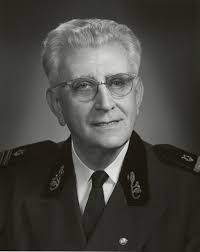
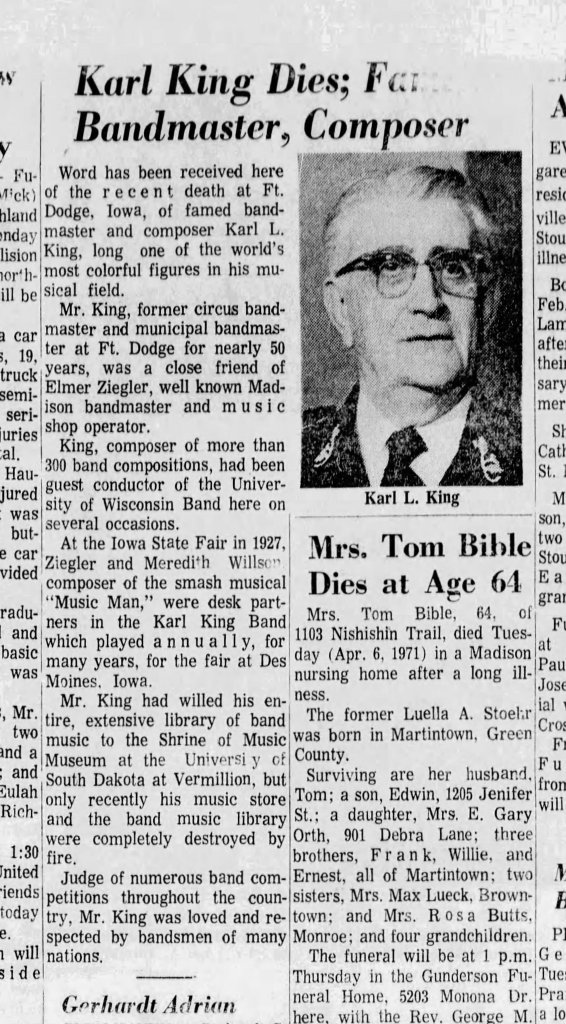
    Karl Lawrence King was one of the most prolific composers of American marching band music, penning almost 300 works. He was born in Paintersville, Ohio in 1891. The story is told that at age eleven, Karl bought a cornet with money he had earned selling newspapers. By that time, his family had moved to Canton, Ohio and he had been taking cornet lessons for a few years. King soon switched to trombone and euphonium and joined a youth band known as the Canton Marine Band. He was not formally trained in music, actually had little schooling at all, and learned musical composition on his own. By his late teens, King was supporting himself playing in local bands and circus bands. When King was in his early twenties, he had already performed and conducted a number of bands and was writing his own music.

    He married the former Ruth Lovett in 1916 and three years later the couple had their son, Karl L. King, Jr. Ruth was a keyboard player and they had reportedly met while she was working as a calliope player in Barnum and Bailey’s circus band. The young family relocated to Canton, Ohio where Karl started his own music publishing company. They moved to Fort Dodge, Iowa in 1920 and would be based there for the rest of Karl’s career. King served as conductor of the Fort Dodge Municipal Band for fifty-one years. The band became very well known, had a radio program on station WHO in Des Moines, Iowa and played at almost every Iowa State Fair beginning in 1920.

    During his life, King composed many different styles of music in addition to marches, including overtures, intermezzos, galops, waltzes, rags and serenades while Ruth operated a business selling musical instruments.

    Many of his pieces were composed during his years with circus bands, or were reminiscent of the circus band genre. He also composed works for universities of the old Big Ten Conference. One of his most famous works, “Barnum and Bailey’s Favorite” was also one of his earliest works, composed in 1913. Other familiar compositions included “Emblem of Freedom.” “The Big Cage,” “Cyrus the Great,” “Pride of the Illini” and many others.

    The great composer died in late March, 1971. Ruth survived him until 1988 and both are buried in the North Lawn Cemetery in Fort Dodge. As a tribute to them both, Ruth’s epitaph reads as follows, “A matchless queen to keep him company. Truly a royal family.”

    (King’s obituary in The Capital Times, Madison, Wisconsin, 7 April 1971.)


    An example of King’s work: Barnum and Bailey’s Favorite (Youtube).

    , ,

  • By Mike Magers

    Claudio Grafulla was born in 1810 (some sources say 1812) on the island of Minorca, a Mediterranean possession of Spain. He was a french horn player and moved to the United States when he was twenty-eight years old. Living in New York, he was a member of Napier Lothier’s Band, part of the 7th Regiment of the 107th Infantry of the New York National Guard. Grafulla became better known as a composer, arranger and conductor and he later served as the conductor of the band. One of its performance highlights was the occasion Grafulla and his band performed at Ford’s Theater in Washington, D. C. on December 8, 1864 for an audience that included President Abraham Lincoln. President Lincoln was assassinated in April of 1865.

    Though Grafulla was recognized as an arranger, he composed many different works in a number of different styles, including marches, waltzes, schottisches and galops. Some of his best known works are Washington Grays (also known as Washington Greys), Freischütz Quickstep, Captain Shepherd’s Quickstep, Captain Smith’s Quickstep and Big Thunder.

    Quoting his Findagrave entry, “Grafulla composed Washington Greys in 1861 for the 8th Regiment, New York State Militia. This work has been called a march masterpiece, a band classic, and the prototype of the concert march. Showing the stylistic influence of both German and Italian marches, the march has a marvelous balance of technique and melody in a continuous flow of musical ideas. It dared to break the old formulas, however, because it has no introduction, no break strain, and no stinger.”

    (Grafulla’s funeral, as reported in the Chicago Tribune, December 9, 1880)

    Grafulla never married and it has been said that he lived for his music. Upon his death in 1880, he was buried in Green-Wood Cemetery, Brooklyn, New York.


    An example of Grafulla’s work: Washington Grays (Youtube).

    , ,

  • By Mike Magers

    “Boy Soprano Cared More for Cave Than Warbling for Sousa”

    This was a headline in the Fort Worth Star Telegram, December 24, 1925. The great band leader had come to the Panhandle to do a concert. Thirteen year old “Balie” (actually spelled Bailey) Warren had been invited to sing for the Sousa Band over the initial objections of John Phillip Sousa, who had said that the band carried its own soloist. Sousa relented and young Bailey was asked to sing.

    The article related that the boy was well known in the area as a soloist and came to sing with the band, but that he had been anxious to get back to a cave that he and his pals were digging in his back yard. Young Bailey was typically fearless before a crowd and did well that day, but at the end of the concert, he took off for home to return to his friends and the cave they were digging.

    “Good night,” he exclaimed, disgustedly: “that’s the way it always goes when I am trying to do something. The kids have gone home, and we can’t finish the cave until tomorrow,” the article concluded, quoting Bailey.

    The 1930 Census showed that the 17 year old Bailey was living with his parents and working at a radio station in Amarillo. It’s thought that the family then moved to California. In the 1940 Census, Bailey was still living in California in that report, he listed his occupation as singer and entertainer. Bailey apparently went on to have a career in the radio-television business.


    , , ,