Tag: bands


  • by Heritage Brass Band

    The origin of this band dates back to the 1880s when President Lawrence Sullivan “Sul” Ross invited a Czechoslovakian immigrant named Joseph Holick to make boots for the cadets on the college campus in central Texas. The story continues that Holick, a cobbler by trade, also played the clarinet and had some capability as a bugler. The latter caused him to be invited to play “Taps” and “Reveille” at cadet corps functions in exchange for a small stipend. Holick was then asked if he would start a band from the cadet corps. Holick did so and the band gradually grew from its thirteen original members to the premier band organization that it is today.

    Link to more complete historical article from MyTexasAggie.com

    image courtesy TheEagle.com

    In addition to the Fightin’ Texas Aggie Band, the university also has other musical organizations, including four concert bands (the Wind Symphony, Symphonic Winds, Symphonic Band and Concert Band) two jazz bands, the Aggieland Dance Orchestra and the University Orchestras (the Philharmonic Orchestra and the Chamber Orchestra). 


    YouTube link to Fightin’ Texas Aggie Band performing “Patton” adapted from composition by Dominic Hauser.
    ,

  • By Mike Magers

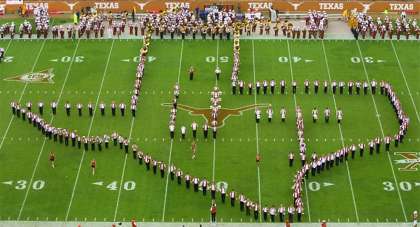
    The famous Texas Longhorn Band was founded at the University of Texas in 1900 by a chemistry professor, Dr. Eugene Schoch. With the aid of another professor, Dr. H. E. Baxter, they purchased about $150 of instruments from a local pawn shop. The first band was made up of eighteen students. Dr. Baxter was the director for the first five years until he was succeeded by Dr. Schoch. For a number of years, the band was led by students until Mr. Burnett Pharr became the director around 1917. The band continued to grow and evolve under various directors including Col. George E. Hurt (1936-1949), Moton Crockett (1949-1955), Dr. Vincent DiNino (1955-1975), Tom Rhodes, Glenn Richter, Paula Crider, Kevin Sedatole, Dr. Robert Carnochan and Dr. Scott Hanna (the current director).

    Image courtesy San Antonio Express-News

    Among the traditions of the band, which include their signature burnt orange uniforms, is “Big Bertha,” the massive bass drum that is called the “Sweetheart of the Longhorn Band.” Director Moton Crockett arranged for the purchase of the large instrument, built by the C. G. Conn company for another school, the University of Chicago, in 1922. When the University of Chicago discontinued playing varsity football in 1939, the eight foot high drum went into storage and was returned to the instrument manufacturer. The Longhorn Band became aware of its availability and set about to acquire it. As of this writing, the large bass drum is nearly 100 years old. Her dimensions are roughly eight feet by forty-one inches and she is elevated another two feet when on her carriage.

    image courtesy utexas.edu

    At last report, the Longhorn Band numbers about 375 students who register for a year round course in the Butler School of Music.


    YouTube link to the Longhorn Band performing “March Grandioso” composed by Roland Forrest Seitz.


  • by Heritage Brass Band

    A Navy band was displaced by the Japanese attack on Pearl Harbor, December 7, 1941.

    Once they were bandsmen, they became cryptoanalysts, operating out of “Pearl.” They used their unique talents to break the Japanese code.

    https://auburnpub.com/news/local/roger-hare-admiral-nimitzs-secret-weapon-pearl-harbor-musicians/article_9680603c-e84d-5647-b00e-3d64bb1a91e6.html

    Unnamed band on the deck of the USS Missouri, 1945, on the occasion of the Japanese surrender. (https://www.cpf.navy.mil/news.aspx/110822)