Tag: composers


  • The music to the Mexican national anthem, “Himno Nacional Mexicano,” was composed by Jaime Nunó, a Spanish-born composer. Nunó was a military bandmaster, who adapted an existing melody for the anthem in 1854.

    The lyrics were written by Mexican poet Francisco González Bocanegra. A legend around Bocanegra notes that he first entered the contest, but then declined to participate for some unknown reason. His fiancé then locked Bocanegra in a room with historical themes until he consented and wrote the lyrics.

    The work was officially adopted on September 16, 1854, and formalized by decree in 1943, with performance rules established in 1984.

    Youtube, long version


    El Heraldo de Brownsville,
    July 21, 1958 ·Page 4


    [Loose translation from Spanish to English]

    Anniversary of the Author of the Mexican National Anthem
    MEXICO CITY, D.F. — UPI —

    This Friday marked the fiftieth anniversary of the death of Don Jaime Nunó, a distinguished Catalan musician and author of none other than the music for the Mexican National Anthem.

    Don Jaime Nunó, achieved notoriety along with the inspired Mexican poet Francisco González Bocanegra, the author of the words to the patriotic song. Bocanegra was born in San Juan de las Abades, a town in the province of Gerona, region of Catalonia, Spain, after having lived in the New World, in Cuba and Mexico. He died in New York on this Friday, 1908, exactly 50 years ago.

    Don Jaime Nunó was living in Cuba when, for the third time, the government headed by Don Antonio
    Lopez de Santa Anna issued a call for entries to write the music and lyrics for the National Anthem.
    Nunó submitted the immortal music born of his inspiration to the competition, and his surprise was great and pleasant when he learned of the triumph that had been awarded to him, without dispute, unanimously, because no one like him managed to touch so strongly the emotional fiber of the Mexican soul or to provide a better framework for the practical and lofty verses of González Bocanegra.


  • John Philip Sousa, known as the March King was in North Texas at the Denton, Texas College of Industrial Arts, an all female school now known as Texas Woman’s University. The famous conductor had come to the area in the fall of 1928 as part of his Golden Jubilee Tour and scheduled two concerts at the college in Denton. After one of the performances, Sousa was presented with a petition signed by 1,700 the students requesting that he compose a march just for them. Sousa agreed and asked the students to suggest names for the musical piece. As far as we know, he received no suggestions for the name but composed the march we now know as “Daughters of Texas.”

    Another wrinkle in the story is as follows. Sousa was nearing the end of his long career and he was also asked by Minnesota businessman Wilbur B. Foshay to bring his band to Minneapolis in 1929. The occasion was to be a four day celebration that would include the dedication of a structure to be known as the Foshay Tower. It was an office building that was to somewhat resemble the Washington Monument.

    Various accounts note that Sousa was in the process of composing his march for the Denton college but in the interest of time, he reportedly adapted his work in progress and used it for the Minnesota celebration. That piece was renamed the “Foshay Tower Washington Memorial March” and was performed there but never published. Sousa then composed a different march for the Denton school. Supposedly, early copies of both marches still exist in some form. The Minnesota trip took place and and the the Foshay Tower was dedicated. Now almost 100 years old, it still stands in Minneapolis today and is currently operated as a hotel.

    The Brattleboro Reformer,
    Brattleboro, VT, March 20, 1929

    The Denton Record-Chronicle reported that the new march named “Daughters of Texas” had been completed in the summer of 1929. The article below from the same newspaper notes that the first copies of the march were delivered to the College of Industrial Arts (C. I. A.) the following year.

    Denton Record-Chronicle,
    Denton, TX, April 29, 1930

    United States Marine Band playing “Daughters of Texas” (YouTube)


  • by Heritage Brass Band

    John Philip Sousa, the renowned American composer and conductor known as the “March King,” died on March 6, 1932, in Reading, Pennsylvania. He passed away at the age of 77 from heart failure while staying at the Abraham Lincoln Hotel. The great conductor had lead a rehearsal with the Ringgold Band earlier that day and died in his sleep that night. His body was taken to Washington, D.C., where a funeral was held at St. Agnes Church, followed by burial at Congressional Cemetery on March 10, 1932.

    Clippings from the Reading (Pennsylvania) Times, 3/7/1932

    , , ,

  • By Mike Magers

    The individual who wrote the lyrics to our National Anthem, “The Star Spangled Banner,” was Francis Scott Key (1779 – 1843), an American lawyer born in Maryland. He practiced law in Maryland and was well known in District of Columbia life. In addition to his law practice, he wrote poems, hymns and articles on legal topics. Key was an Episcopalian by faith. He was active in his denomination and his personal faith was reflected in his hymns and other compositions.

    A listing of his hymns would include the following(1):

    • Faith
    • If Life’s Pleasures Charm Thee
    • Lord, With Glowing Heart I’d Praise Thee
    • L. M./God, Art Thou My Father?
    • Praise for Redemption
    • The Home of the Soul
    • The Bethel Flag
    • When Troubles Wave on Wave Assailed

    Some of his writing was posthumously published by his brother-in-law. Favorite topics of Key’s centered around patriotism, religious faith and related themes. His most famous work, however was “The Star-Spangled Banner.”

    The ultimate origin of the melody or tune is said to be unknown, though it is attributed to John Stafford Smith, (1750-1836). Smith was a British composer, organist, and musicologist best known for writing the melody for “The Anacreontic Song,” which later was paired with Key’s poem and adopted as the tune for the national anthem of the United States, “The Star-Spangled Banner,” in 1931.

    Key’s poem was written during the War of 1812 and specifically a battle in 1814 in which British forces bombarded Fort McHenry by British forces. Key was inspired by seeing that the American flag had endured the British naval attack.


    One hundred years later, the Austin American in its issue of August 2, 1914 carried the following article:

    State Program, Daughters of 1812

    In accordance with the proclamation that has been issued by Governor O. B. Colquitt to the people of Texas to celebrate the centennial of the Battle of Baltimore and the writing of the “Star Spangled Banner” by Frances Scott Key, a program has been arranged by the Daughters of the United States War of 1812 in Texas for that occasion.

    The proclamation was issued by invitation of the Governor of Maryland to the Governors of all the States to make the writing of our National air a National and State as well as local affair.

    It is earnestly requested by the tate committee Daughters of 1812, to whom Governor Colquitt entrusted the program for the celebration, that every city, every school and church will join in the celebration. The following is the program:

    Program

    Centennial celebration of the writing of the “Star Spangled Banner,” September 13, 1914, arranged by the United States Daughters of 1812 in Texas:

    Call to order and introduction by the Mayor.
    Invocation. minister.
    Song, “America,” audience and band.
    Song, “Lead. Kindly Light,” choirs of churches.
    Song, “Star Spangled Banner,” school children.
    Address, “Christian Citizenship,” minister.
    Lord’s prayer, audience.
    Music, “Columbia, the Gem of the Ocean,” “Star Spangled Banner, band.

    All military organizations, navy. labor day committees and public at large are invited to assist.

    Committee: Mrs. E. P. Smith, chairman; Mrs. George Massie, Mrs. 0. B. Colquitt, Mrs. J. E. Howze, Miss Ethel Bowman, Miss Imogen Fulmore.


    (1) Hymnary.org


  • by Heritage Brass Band

    One of the wonderful songs in our large “book” of music is called “Harlem Nocturne.” Linked below is an excellent biography of the composer by Wayne S. Walker. The author provides an interesting look into the life and musical career of Mr. Hagen.

    ,

  • by Heritage Brass Band

    Over the years, the band has played a lot of Stephen Foster compositions and has also recorded a CD called The Unknown Stephen Foster of only his songs. Please enjoy this biography of the wonderful American composer Stephen Foster.

    Image credit – Discogs.com

    , ,

  • by Mike Magers

    The song alternately known as the “Navy Hymn,” “For Those in Peril on the Sea” or “Eternal Father, Strong to Save” dates back to 1860. During the 19th century, hymnbooks typically included sections of hymns devoted to the subject of divine protection for travelers, particularly for naval travel.

    This hymn has likely been the most commonly performed piece of that type over the years. The words were written by clergyman William Whiting and the melody was composed by clergyman and musician John B. Dykes, both of the United Kingdom. Hymn tunes are given names and Dykes named his composition “Melita” in reference to the island where the biblical apostle Paul was shipwrecked in Acts 27. Whiting, who lived in London, is said to have written the words to go with the melody to comfort a young person who was about to set sail for America.

    Whiting (1825−1878) was Master of an Anglican school for musicians and had himself survived a violent storm at sea during which the ship was in danger of being lost. While teaching at the Winchester College Chorister’s School, the story is told, he was approached by a student who related his fear of traveling to Whiting. In response, Whiting wrote a poem that became the basis for the words of the hymn which was published about a year later. Whiting continued to modify the words of the songs as long as he lived, but the words commonly used in hymnbooks have remained relatively standard for many years.

    John Bacchus Dykes (1823−1876) came from a family that included a number of clergymen, but his gift was music. It is said that he was proficient on various instruments, primarily keyboards, violin and horn, and he had been involved performing and composing religious music since his youth. Dykes primarily worked as a church musician and composed complete hymns, dozens of hymn tunes and edited hymnbooks. In addition to the hymn tune used for the Navy Hymn, Dykes also composed “Nicaea” which many would recognize as the melody for the hymn “Holy, Holy, Holy.”

    Use of this hymn by the United States Naval Academy is believed to date back to around 1879 when Rear Admiral Charles Jackson Train instituted it as part of Sunday divine services at the Academy.

    The hymn was gradually added over time to the naval military traditions of the United States, Great Britain and France. It has also been associated with historical occasions. It is said to have been the favorite hymn of President Franklin Delano Roosevelt and was sung at his funeral. It was also performed as the casket of President John Fitzgerald Kennedy was carried up the steps to the United States Capitol Building to lie in state.


    Youtube link to the United States Naval Academy Glee Club performing the Navy Hymn, acapella version.

    Youtube link to the United States Marine Band performing an instrumental version of the Navy Hymn.

    Dedicated to Lieutenant Commander Carl B. Bolin, USN.


  • By Mike Magers

    Frank White Meacham was born in Buffalo, New York in 1856 to John Horace Meacham and Mary Emma Page Meacham. He was the middle child of at least five siblings. In the 1865 census, John Horace’s profession was listed as broker and in the 1875 census when Frank was 19, John Horace’s profession was listed as (possibly carriage) manufacturer. Five years later in the 1880 census, Frank was living with his family at age 24 and his profession was listed as musician. Little appears to be documented about his musical training.

    Frank married the former Cora B. Collins. In the 1892 New York census, he was 36 and she was 26. His profession was listed as musician. No children were listed. Frank Meacham lost both parents as a result of a buckboard/train accident on November 20, 1894. The buckboard in which they were riding was hit by an oncoming train at an at grade crossing in Germantown, Pennsylvania where they were residing. Mr. Meacham was killed instantly. A railroad flagman and Mrs. Meacham died shortly thereafter from their injuries.

    Frank is known to have composed a number of songs, beginning with “Come Over the Sea” which is said to have been composed when he was only 10 years old. The Library of Congress contains images of a number of his compositions including “Come Over the Sea” published in 1877 by Chandler Brothers, “The Tar’s Farewell” also published by Chandler Brothers in 1878, a collection including “My Little Bouquet,” “Locust Grove Waltzes,” “Woodland Nymphs Galop,” “Esopus,” “Tarantelle” and “Rosenvik Waltzes” published in 1880 by George Molineaux of Brooklyn and “Celestial Waltzes” also published by Molineaux in 1881. He is also believed to have arranged and ghost written songs for others.

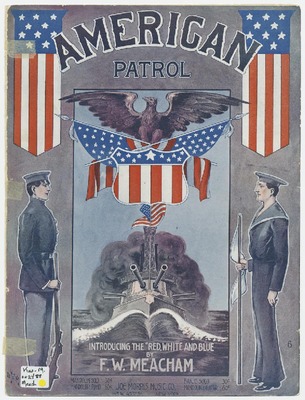
    His most enduring composition has been “American Patrol.” Originally a piano piece, it was copyrighted in 1885. The first band arrangement is believed to have been published by Carl Fischer in 1891 and published again in 1919 by his widow Cora Meacham. In an interesting cross-genre application, the melody and basic themes were again arranged for swing band by Jerry Gray and later by composer Morton Gould. The swing band arrangement was recorded and made popular by the Benny Goodman band.

    Image credit: umaine.edu

    Meacham died in 1909 and is interred along with his parents at Albany Rural Cemetery in Menands, New York.


    Frank W. Meacham’s American Patrol – Youtube

    ,

  • By Mike Magers

    Wagner was the composer of a well known march called “Under the Double Eagle” in 1893. It has been so often performed by United States bands over the years that it could easily be mistaken to be an American patriotic work.

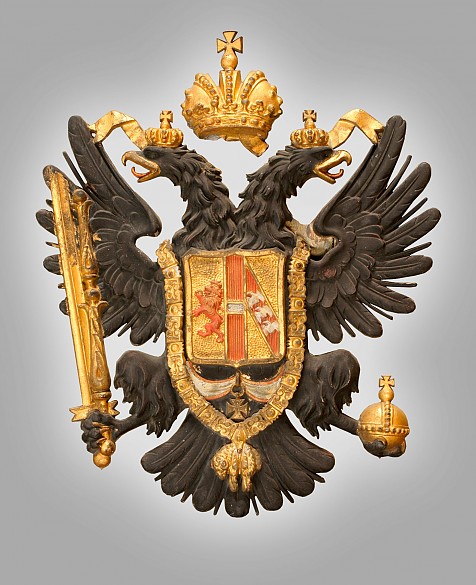
    What was the double eagle? J. F. Wagner was Austrian and the double eagle was actually an image common to the Austro-Hungarian coat of arms, illustrated below:

    Image credit: habsberger.net

    The image depicted the two headed eagle to represent the two halves of the Austro-Hungarian empire. It was not exclusive to the Austro-Hungarian double monarchy, since it was used centuries earlier by ancient cultures including the Roman Empire and was more recently used by Albania. It has appeared widely in national cultures, including on stamps of the countries, symbolic of courage, national unity and strength.

    Josef Franz Wagner was born in Vienna in 1856. His father was a doctor and Wagner received his basic musical education at the Royal Military Institute in Kaschau, Hungary. Around 1878 he was appointed bandmaster of the Royal 47th Infantry Regiment Band. Fourteen years later, he accepted a similar position with the 49th Infantry Regiment where he remained until his retirement seven years later, at least partly attributed to the fact that bandsmen had no pension benefits whereas military personnel were eligible for them. After his military retirement, Wagner was still in his 40s. He continued to compose and organized a civilian musical group. In addition, he is believed to have become popular as a conductor. Unfortunately he died at the age of 52 in 1908 of heart disease.

    During his lifetime, he is estimated to have written anywhere from 400 to 800 compositions, at least 250 of which are known to have been published. He composed his famous and perhaps most familiar (in the U. S.) march called Unter dem Doppeladler in 1893 and the music was published shortly thereafter.

    It has become a popular concert piece of concert bands. The Sousa band championed the work and accounts say it was recorded by Sousa three different times. It has since also become a popular crossover song in other genres and has been recorded and performed even by country music and bluegrass music artists.

    The march passes the bear test: On May 8, 1909, the Gazette (Cedar Rapids, Iowa) posted a humorous article about the playing of this piece on a Victrola-type record player for animals in the local zoo. The article stated the familiar adage that “music could soothe the savage beast” and listed several recordings that were played for the caged animals on the “talking machine” that had been placed on a borrowed orange crate. The first piece was a violin recording of a number by a Russian “with an unpronounceable name.” The two black bears, Bill and Gussie, seemed to like it. Then they played “Under the Double Eagle,” which the writer erroneously attributed to Sousa, the bears first retreated to their den before emerging again to walk around their cage, stopping on each circuit to listen to the music. Other pieces were played, including the “William Tell Overture,” ” Stars and Stripes Forever” and many slower numbers, but the bears seemed to prefer “Under the Double Eagle” best.


    J. F. Wagner’s Under the Double Eagle – YouTube

    , , ,

  • By Mike Magers

    Most often known simply as R. B. Hall, this composer lived most of his life in Maine. He was born in 1858 and died in 1907. He was born in Bowdoinham, ME to Mr. and Mrs. Nathaniel W. Hall. Robert took lessons on E-flat cornet from his father and later added B-flat cornet to the instruments he played. His father died in 1874 and Robert took a job at a shoe factory to help provide income for his mother and two sisters. He was eventually able to pursue a career in music and first found employment in music as a cornet soloist. Later he served as conductor of various ensembles and taught music at Colby College.

    His rigorous schedule, combined with stress and ill health, resulted in his early death (likely from complications of nephritis) at age 48. Hall’s memory might have faded into obscurity had it not been for several individuals who championed his talent and musicianship. The last Saturday in June is now known as “R. B. Hall Day” after legislation enacted by the Maine State Legislature.

    Image credit – Nashua Telegraph of November 21, 1977

    His memorable works include “Officer of the Day,” “The New Colonial” and one of our favorites, the lesser known “March RLIB” composed for the Richmond Light Infantry Blues.

    Texas trivia note: The Richmond Light Infantry Blues Band performed at the launching of the first battleship of the United States Navy, named the Texas, in 1892. This warship is not to be confused with the more familiar U.S.S. Texas that saw service in World Wars I and II. The word Blues in the name of the Richmond, Virginia military organization referred to the color of their uniforms and not to a genre of music.


    R. B. Hall’s Officer of the Day (YouTube).

    R. B. Hall’s March RLIB (YouTube).

    R. B. Hall’s Tenth Regiment – Death or Glory (YouTube).