Tag: composers


  • By Mike Magers

    Claudio Grafulla was born in 1810 (some sources say 1812) on the island of Minorca, a Mediterranean possession of Spain. He was a french horn player and moved to the United States when he was twenty-eight years old. Living in New York, he was a member of Napier Lothier’s Band, part of the 7th Regiment of the 107th Infantry of the New York National Guard. Grafulla became better known as a composer, arranger and conductor and he later served as the conductor of the band. One of its performance highlights was the occasion Grafulla and his band performed at Ford’s Theater in Washington, D. C. on December 8, 1864 for an audience that included President Abraham Lincoln. President Lincoln was assassinated in April of 1865.

    Though Grafulla was recognized as an arranger, he composed many different works in a number of different styles, including marches, waltzes, schottisches and galops. Some of his best known works are Washington Grays (also known as Washington Greys), Freischütz Quickstep, Captain Shepherd’s Quickstep, Captain Smith’s Quickstep and Big Thunder.

    Quoting his Findagrave entry, “Grafulla composed Washington Greys in 1861 for the 8th Regiment, New York State Militia. This work has been called a march masterpiece, a band classic, and the prototype of the concert march. Showing the stylistic influence of both German and Italian marches, the march has a marvelous balance of technique and melody in a continuous flow of musical ideas. It dared to break the old formulas, however, because it has no introduction, no break strain, and no stinger.”

    (Grafulla’s funeral, as reported in the Chicago Tribune, December 9, 1880)

    Grafulla never married and it has been said that he lived for his music. Upon his death in 1880, he was buried in Green-Wood Cemetery, Brooklyn, New York.


    An example of Grafulla’s work: Washington Grays (Youtube).

    , ,

  • By Mike Magers

    “Boy Soprano Cared More for Cave Than Warbling for Sousa”

    This was a headline in the Fort Worth Star Telegram, December 24, 1925. The great band leader had come to the Panhandle to do a concert. Thirteen year old “Balie” (actually spelled Bailey) Warren had been invited to sing for the Sousa Band over the initial objections of John Phillip Sousa, who had said that the band carried its own soloist. Sousa relented and young Bailey was asked to sing.

    The article related that the boy was well known in the area as a soloist and came to sing with the band, but that he had been anxious to get back to a cave that he and his pals were digging in his back yard. Young Bailey was typically fearless before a crowd and did well that day, but at the end of the concert, he took off for home to return to his friends and the cave they were digging.

    “Good night,” he exclaimed, disgustedly: “that’s the way it always goes when I am trying to do something. The kids have gone home, and we can’t finish the cave until tomorrow,” the article concluded, quoting Bailey.

    The 1930 Census showed that the 17 year old Bailey was living with his parents and working at a radio station in Amarillo. It’s thought that the family then moved to California. In the 1940 Census, Bailey was still living in California in that report, he listed his occupation as singer and entertainer. Bailey apparently went on to have a career in the radio-television business.


    , , ,

  • By Mike Magers

    Composer Henry Fillmore was born December 3, 1881 in Cincinnati, Ohio. His father was James Henry Fillmore, a composer of gospel songs. Henry was something of a musical prodigy and as a youth, he learned to play the piano, guitar, violin, flute and trombone, which incidentally became his favored instrument. He was educated at the Cincinnati Conservatory of Music.

    During his long career Fillmore was a composer, band leader, music publisher among his many other interests. He was a prolific composer, penning 250 or more works. Not wanting to flood the market with compositions in his name, he published under pseudonyms including Harold Bennett, Al Hays, Harry Hartley and Ray Hall, among others. He is widely recognized as one of the “March Kings” of that genre.

    Some of his best known compositions are: The Footlifter, Americans We, The President’s March, The Klaxon, Lassus Trombone, The Circus Bee. Many of his popular works were written as pieces to feature his favored instrument, the trombone.

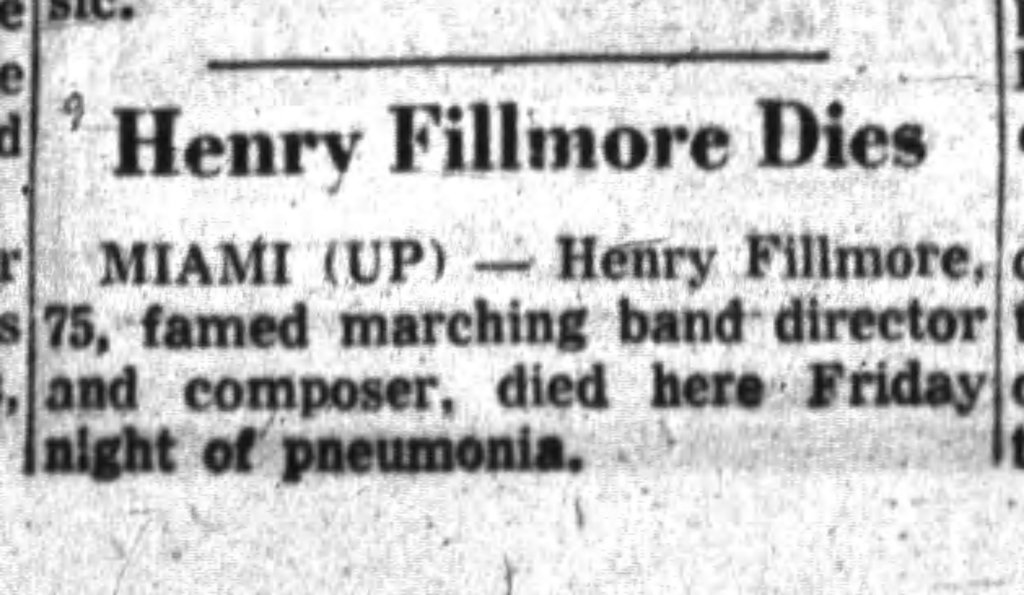
    Fillmore died in 1956 in Miami, Florida at age 75.

    (Fillmore’s death, reported by The Anniston Star, Anniston, Alabama. 8 Dec 1956.)


    An example of Fillmore’s work: The Footlifter – Youtube

    ,